
Electrical Repair in Chilliwack:
The Complete Homeowner's Guide
Chris Nickel
Red Seal Journeyman Electrician — CN Electrical, Chilliwack, BC
The single most common electrical repair in Chilliwack homes is a tripped or failed circuit breaker caused by an overloaded circuit. In most cases, the root issue isn't the breaker itself — it's too many devices pulling from one circuit, a loose connection at a receptacle, or a double-tapped breaker terminal that's been degrading for years. A licensed electrician in Chilliwack can diagnose and fix this in under two hours for about $150–$400 including the service call and first hour of labour. Read on to understand every common electrical repair scenario, what they cost, which ones you can handle yourself, and how to hire the right electrician for the job.
Every homeowner in Chilliwack eventually faces an electrical problem. A light switch stops working. A breaker trips and won't reset. An outlet goes dead — usually the one behind the couch you only use at Christmas. When it happens, the first question isn't usually "what caused this?" — it's "how much is this going to cost me, and how fast can someone fix it?"
This guide answers both questions — and everything in between. It's written for Chilliwack homeowners who want to understand their electrical system well enough to make smart decisions: what's urgent, what can wait, what you can safely fix yourself, and when you need to pick up the phone and call a licensed electrician. At CN Electrical, our residential electrical repair and diagnostics service handles these calls every week across Chilliwack, Sardis, Promontory, and the surrounding areas, so everything here is drawn from real jobs — not generic advice. To see the full range of what we do, visit CN Electrical in Chilliwack for our complete residential, commercial, and industrial service list.
Whether you're dealing with a buzzing panel in a 1970s rancher, persistent flicker in a new-build kitchen in Garrison Crossing, or a dead outlet in a Promontory two-storey, the principles in this guide apply. We'll cover the most common electrical repair problem first — the one search engines tell us thousands of Canadians type into Google every month — then work through warning signs, costs, the DIY line, and how to hire the right electrician in Chilliwack.
If you're specifically dealing with a panel that can't keep up, our detailed guide on when to upgrade your electrical panel covers panel-specific warning signs, costs, and the 200A upgrade process. For lighting problems specifically, our LED lighting upgrade savings guide breaks down fixture replacement costs and energy savings. And if you're in an older home, don't miss our electrical safety guide for older Chilliwack homes.
What You'll Learn in This Guide
Click the quick-links below to jump to any section.
- 1.The #1 Most Common Electrical Repair Problem Homeowners Face — and Why
- 2.8 Warning Signs You Need Electrical Repair — Don't Ignore These
- 3.What You Can Fix Yourself vs. What Needs a Licensed Electrician
- 4.What Electrical Repair Actually Costs in Chilliwack, BC
- 5.The 10 Most Common Residential Electrical Repairs
- 6.Panel Repair vs. Panel Upgrade — How to Know Which One You Need
- 7.Do I Need a Permit for Electrical Repair in BC?
- 8.How to Hire the Right Chilliwack Electrician for Your Repair
- 9.Preventative Electrical Maintenance — Stop Repairs Before They Start
- 10.Frequently Asked Questions About Electrical Repair in Chilliwack
Plus: real cost ranges for Chilliwack electrical repairs, BC permit requirements, and preventative maintenance tips to avoid future repairs.
The #1 Most Common Electrical Repair Problem Homeowners Face — and Why
If you type "why does my..." into Google, the autocomplete tells you everything you need to know about the most common electrical problems: why does my breaker keep tripping, why does my light flicker, why does my outlet not work. These three questions account for the overwhelming majority of residential electrical repair searches — and they all point to the same underlying issue.
The single most common electrical repair in Chilliwack — and across North America — is a circuit overload causing a breaker to trip. The breaker itself is rarely defective. What's happening is that too many devices are pulling current from the same circuit simultaneously, exceeding the breaker's amp rating. A 15-amp breaker is designed to trip when the load exceeds 15 amps (or 12 amps continuously under the Canadian Electrical Code's 80% rule). Run a toaster (8-10 amps), a kettle (10-13 amps), and a microwave (12-15 amps) on the same kitchen circuit, and you're tripping the breaker every time.
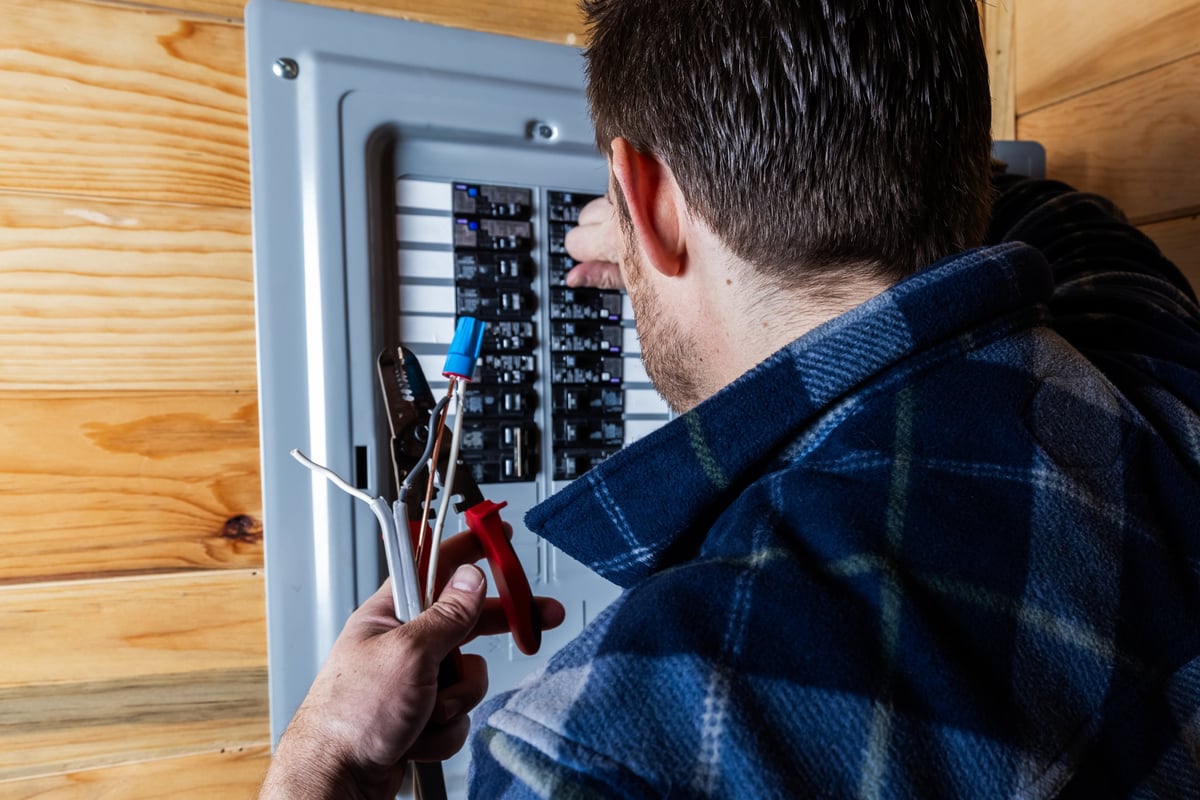
But here's what most homeowners don't realize: the problem isn't always just too many things running at once. In many Chilliwack homes — particularly those built between 1985 and 2010 — the root cause is a loose connection. A backstabbed receptacle (where the wire is pushed into a spring-clip terminal instead of wrapped around a screw) weakens over years of thermal expansion and contraction. The connection degrades, resistance increases, heat builds, and eventually the breaker trips — or worse, the connection arcs and burns without ever tripping the breaker.
Safety Warning
A breaker that trips occasionally under heavy load is doing its job. A breaker that trips repeatedly — or a receptacle that's warm to the touch, discoloured, or smells like burning plastic — is a fire hazard. Turn off the circuit at the panel and call a licensed electrician immediately. Do not keep resetting it.
The good news is that a circuit overload or loose-connection repair is typically one of the most affordable electrical fixes — usually a 1-2 hour service call for our residential repair electricians. The diagnostic process involves opening the panel, checking torque on every terminal, identifying the affected circuit, and tracing it to the offending receptacle or junction box. In about 70% of cases, tightening or replacing a single receptacle solves the problem permanently.
8 Warning Signs You Need Electrical Repair — Don't Ignore These
Electrical problems almost always announce themselves before they become emergencies. The trick is knowing what to listen for. Here are the eight warning signs that mean it's time to call a licensed electrician in Chilliwack — ranked from "schedule a service call this week" to "turn off the breaker and call us right now."
1. Flickering or Dimming Lights
If your lights dim momentarily when the fridge compressor kicks on or the furnace starts, a large appliance is drawing inrush current on a shared circuit. If it's subtle and only happens for a split second, it's usually normal. But if the dimming is pronounced — or if lights brighten in one part of the house while dimming in another — you may have a loose neutral connection at the panel or meter base. This is a serious condition that causes voltage to swing unpredictably across your home and can damage electronics or start a fire. Call an electrician.
2. Breakers That Trip Repeatedly
A breaker that trips occasionally when you run the microwave and toaster at the same time is doing its job. A breaker that trips every time you use a specific outlet — or trips with nothing plugged in — needs immediate attention. It could be a failing breaker, an overloaded circuit, or a short circuit somewhere in the wiring. Each of these has a different fix and a different price tag, but none of them improve by being ignored.
3. Warm, Discoloured, or Vibrating Outlets
An outlet should never be warm to the touch. Warmth means resistance — and resistance means heat buildup inside the electrical box. Discoloration (brown or yellow marks around the plug slots) means arcing has already occurred. If you can feel vibration when you plug something in, the contacts inside the receptacle are worn and the plug is loose — another arcing risk. Any of these three signs means the receptacle needs to be replaced, and the circuit should be inspected for additional damage.
4. Burning Smell or Scorch Marks
A burning or "fishy" smell near an outlet, switch, or the electrical panel is an urgent warning sign. The plastic housing, wire insulation, or surrounding building material is overheating — and potentially already smouldering inside the wall. Turn off the circuit at the panel immediately and call a licensed electrician. Do not use the affected outlet or switch until it's been inspected and repaired. This is one of the most common precursors to electrical fires.
5. Buzzing, Humming, or Crackling Sounds
Your electrical system should be silent. A buzzing panel can indicate a loose breaker that's arcing against the bus bar. Humming from a light switch or outlet suggests a loose wire vibrating at 60 Hz. Crackling is the sound of arcing — electricity jumping across a gap — and it's the most dangerous sound your electrical system can make. Any of these sounds warrant an immediate service call.
6. Outlets That Don't Work — or Only Work Intermittently
A dead outlet is often the result of a tripped GFCI elsewhere on the same circuit. One GFCI receptacle can protect up to 12 downstream outlets, so a tripped GFCI in a bathroom can kill power to outlets in the garage, on the porch, or in a second bathroom. Check every GFCI in the house and press "reset" before calling an electrician — this simple step saves you a $150 service call. If all GFCIs are reset and the outlet is still dead, the problem is a failed receptacle or a broken connection in the circuit, and you'll need a pro.
7. Sparks When Plugging In or Unplugging
A small blue spark when you unplug a running appliance is normal — the circuit is under load and briefly arcs as the connection breaks. But a large, bright, or sustained spark — especially one that leaves a burn mark or makes an audible "pop" — indicates worn contacts inside the receptacle or a loose connection. Replace the receptacle.
8. Mild Electric Shock or Tingling from Appliances or Switches
If you feel a tingle when touching a metal appliance, switch plate, or lamp, there is a ground fault — current is leaking to a surface that should not be energized. This is dangerous. It means the grounding system in your home is compromised or the appliance itself has an internal fault. Stop using the affected device and have an electrician trace the ground fault. This is also a strong indication that your home may lack GFCI protection in wet areas — an affordable upgrade our kitchen and bathroom electrical team handles regularly.
What You Can Fix Yourself vs. What Needs a Licensed Electrician
In British Columbia, homeowners are legally permitted to perform electrical work on their own single-family dwelling under the Safety Standards Act — but that permission comes with a lot of fine print. DIY work must still comply with the Canadian Electrical Code, requires a homeowner permit from Technical Safety BC, and must pass inspection. For rental properties, condos, townhouses with strata rules, and flips, you must use a licensed contractor — no exceptions.
Legal aside, here's the practical breakdown of what's worth doing yourself and what isn't.
Safe to DIY
- •Replacing a light bulb or fluorescent tube
- •Resetting a tripped GFCI outlet
- •Replacing a standard light switch or receptacle (like-for-like, with power off at the panel)
- •Replacing a light fixture on an existing, code-compliant box
- •Replacing a frayed extension cord or power bar
Call a Licensed Pro
- •Any panel work — even changing a breaker leaves live conductors exposed
- •Adding new circuits, outlets, or switches
- •Tracing and repairing a short circuit or ground fault
- •Aluminum wiring remediation or replacement
- •Any repair where you see scorch marks or smell burning
- •Any work involving knob-and-tube wiring (still found in some pre-1950s Chilliwack homes)
The line between these two columns is where most homeowners get into trouble. Replacing a receptacle seems simple — and it is, when the wiring is copper, the box is grounded, and the circuit is properly labelled. But if you open the box and find aluminum wiring, a shared neutral, or a box that's too shallow for the device you're installing, that simple swap just became a job for a professional.
Our advice: if you're confident in the specific repair and have a voltage tester, a torque screwdriver, and a copy of the circuit directory for your panel, replacing a like-for-like device is reasonable DIY territory. For everything else — including anything that makes you pause and think "I'm not sure about this" — call a licensed Chilliwack electrician. When you're ready to leave it to the pros, you can hire an electrician in Chilliwack online and get a same-week service call booked. The service call costs less than the materials and drywall repair you'll need if you get it wrong.
What Electrical Repair Actually Costs in Chilliwack, BC
Electrical repair pricing in Chilliwack is generally 10-15% below Vancouver metro rates, but it follows the same structure: a service call fee (covering travel and the first diagnostic hour) plus hourly labour and materials after that. Here's what you can expect to pay in 2026.
| Repair Type | Typical Cost Range | Time on Site |
|---|---|---|
| Service call & diagnostics | $95–$160 | First hour |
| Replace a standard receptacle | $120–$180 | 30–60 min |
| Replace a light switch | $110–$170 | 30–45 min |
| Install GFCI outlet (replace standard) | $140–$210 | 45–60 min |
| Diagnose & fix tripping breaker | $150–$400 | 1–3 hours |
| Replace a circuit breaker | $160–$280 | 45–90 min |
| Add a new dedicated circuit | $300–$650 | 2–5 hours |
| Trace & repair a short circuit | $200–$600 | 1.5–4 hours |
| Replace light fixture (existing box) | $140–$300 | 45–90 min |
| Loose connection diagnostic & repair | $150–$350 | 1–2.5 hours |
These are real ranges for licensed, insured electrical contractors in the Fraser Valley. Handyman services may quote lower numbers, but they typically can't pull permits, and their work may not be covered by your home insurance if something goes wrong. Our free estimates are always fixed-price once we've diagnosed the issue — you'll know the total before we pick up a tool.
A note on emergency and after-hours rates: most Chilliwack electricians charge a premium for nights, weekends, and holidays — typically 1.5× to 2× the standard rate. If your repair can wait until the next business day, you'll save significantly. But if you're dealing with a burning smell, exposed live wires, or a panel that's actively buzzing, don't wait — the premium is worth it.
The 10 Most Common Residential Electrical Repairs
After over a decade of service calls in Chilliwack, Sardis, and the Fraser Valley, here are the ten repairs we see most often — what causes them, what they cost, and how they're fixed.
- Tripped breaker / overloaded circuit. As discussed in Section 1, this is the #1 repair call. Diagnosis: clamp-meter the circuit, identify the load, redistribute or add a new dedicated circuit. $150–$400.
- Failed GFCI receptacle. GFCI outlets have a lifespan of 10-15 years. When they fail, they often take 5-10 downstream outlets with them. The fix is straightforward: replace the GFCI, test the circuit, and verify all downstream outlets are protected. $140–$210.
- Loose receptacle or switch. Backstabbed connections degrade over time. The wire pulls out of the spring clip, creating a high-resistance connection that arcs and heats up. We replace the device, pigtail the conductors with wire nuts, and screw-terminate — a permanent fix. $120–$180 per device.
- Flickering lights. Usually a loose neutral at the fixture, switch, or panel. In older Chilliwack homes, it can also be caused by a failing service neutral at the masthead — BC Hydro's responsibility up to the service point, but the homeowner's from the weatherhead down. $150–$500 depending on complexity.
- Dead outlet (non-GFCI). If it's not a tripped GFCI, the outlet has either failed internally or a wire has come loose in the box. We open the box, test for voltage, identify the break, and repair or replace. $120–$200.
- Warm or buzzing panel. A loose breaker on the bus bar, an overloaded bus stab, or a failing main breaker. Panel work is always a pro job — the main lugs are live even with the main breaker off. $200–$800+ depending on whether it's a simple tightening or a panel replacement.
- Aluminum wiring repair. Homes built 1965-1975 in Chilliwack often have aluminum branch circuit wiring. The approved fix is COPALUM or AlumiConn connectors at every device — not a DIY job. $800–$3,000+ depending on the number of devices.
- Exhaust fan replacement. Bathroom and kitchen exhaust fans seize up over time. Replacement involves matching the housing size, verifying the duct connection, and ensuring the circuit can handle the new fan's load. $180–$450.
- Outdoor receptacle failure. Weather, moisture, and temperature cycling destroy outdoor outlets faster than any other device in the home. Replacement with a WR (weather-resistant) GFCI and an in-use weatherproof cover is the permanent fix. $200–$350.
- Undersized service / panel overload. When your home's total electrical demand exceeds the panel's capacity, breakers trip across multiple circuits. This usually means it's time for a service upgrade. For a full breakdown, read our guide on when to upgrade your electrical panel. $1,800–$4,500 for a 100A-to-200A upgrade.
Panel Repair vs. Panel Upgrade — How to Know Which One You Need
Not every panel issue means you need a full upgrade. A loose breaker, a corroded bus bar connection, or a single failed breaker can often be repaired without replacing the entire panel — if the panel itself is still safe and code-compliant. But some panels should be replaced on sight, regardless of what's actually wrong with them.
Repair is usually sufficient when: the panel is less than 20 years old, the bus bars are in good condition, there's no sign of water damage or corrosion, and the issue is isolated to one breaker or one connection. In these cases, our residential electrical repair service can resolve the issue in 1-2 hours.
Replacement is recommended when: the panel is a known fire hazard (Federal Pacific, Zinsco, or certain Pushmatic models), the bus bars are pitted or corroded, there's evidence of water ingress, the panel is 40+ years old, or you're consistently running out of breaker space. In these situations, a panel upgrade or service change is the right call — and it's often cheaper in the long run than repeatedly repairing an aging panel.
Do I Need a Permit for Electrical Repair in BC?
It depends on the scope. In British Columbia, like-for-like replacements — swapping a broken receptacle, switch, or light fixture for an identical new one on the same circuit — generally do not require a permit. But any alteration or addition to a circuit — adding a new outlet, extending a circuit, running new cable, upgrading a breaker to a different amp rating — requires a permit from Technical Safety BC.
When you hire a licensed contractor like CN Electrical, permit management is included in the scope of work. Our permits and compliance service handles the application, schedules the inspection, and ensures the work passes on the first visit. When you DIY, the permit is your responsibility — and unpermitted electrical work can void your home insurance and create major problems when you sell.
Insurance Reality Check
Most home insurance policies in BC contain an exclusion for loss or damage caused by unpermitted electrical work. If an electrical fire starts at a receptacle you replaced without a permit and your insurer can demonstrate the work was done improperly, your claim may be denied. For the cost of a permit ($100-$300 for most residential repairs), you're buying insurance coverage protection — not just regulatory compliance.
How to Hire the Right Electrician in Chilliwack for Your Repair
Not all electrical contractors are the same, and the cheapest quote is rarely the best value. Here are the five questions every Chilliwack homeowner should ask before hiring an electrician for a repair.
- Are you a licensed electrical contractor with Technical Safety BC? Verify their licence number on the TSBC website. An unlicensed operator cannot pull permits, and their work won't be covered by your insurance.
- Will you provide a fixed-price quote before starting work? For most common residential repairs, a licensed electrician should be able to give you a fixed price after a brief diagnostic assessment. Time-and-materials billing is appropriate for complex troubleshooting, but the electrician should be able to estimate the range.
- Do you carry liability insurance and WCB coverage? If the electrician gets injured on your property and doesn't have WCB coverage, your homeowner's insurance may be on the hook. Ask to see the certificate.
- Who will be doing the actual work? Some companies send a licensed electrician to quote the job but then dispatch an apprentice or labourer to do the work. At CN Electrical, the electrician who quotes your repair is the one who performs it — and every electrician on our team is a direct employee, not a subcontractor. For more about who we are and how we work, the Chilliwack electricians at CN Electrical page walks through our team, certifications, and service areas.
- What's your warranty on repair work? A reputable electrical contractor guarantees their workmanship for at least one year, and the materials they install are covered by manufacturer warranties. Get it in writing.
For a more detailed breakdown, our electrical safety guide for older homes includes a section on vetting electricians. And if you're ready to get your repair diagnosed, call CN Electrical at 1-604-798-1847 or request a free estimate online.
Preventative Electrical Maintenance — Stop Repairs Before They Start
The cheapest electrical repair is the one you never need. Here's a preventative maintenance checklist that takes less than an hour and can catch problems before they become emergencies.
- Test every GFCI monthly. Press "test" — it should click and cut power. Press "reset" — power should restore. If either button doesn't work, the GFCI has failed and needs replacement. Your home should have GFCI protection in kitchens, bathrooms, laundry rooms, garages, crawl spaces, and all outdoor receptacles.
- Feel your panel once a season. Place your hand on the panel cover. It should be room temperature. Warmth means a breaker is running hot — schedule an inspection.
- Look at every receptacle you can access. Discoloration, cracks in the faceplate, or outlets that don't hold plugs firmly are all signs the receptacle should be replaced.
- Listen for buzzing or crackling. Walk through your home in the evening when it's quiet. Any buzzing from switches, outlets, or the panel means a loose connection — schedule a service call.
- Check your service entrance. Look at the masthead and weatherhead where the BC Hydro lines enter your home. If the conduit is rusted, leaning, or pulling away from the house, water may be entering the service — a major hazard. Call an electrician.
- Map your circuits. Every breaker in your panel should be labelled with the rooms and appliances it serves. If your panel directory is blank or illegible, spend 30 minutes with a lamp and a helper identifying each circuit. This saves an electrician diagnostic time — and saves you money on the service call.
- Schedule a professional electrical inspection every 5-10 years. A licensed electrician can identify loose connections, undersized wiring, and code violations before they become repair emergencies. For homes built before 1990, aim for every 5 years. Our residential electrical repair and diagnostics service includes a comprehensive safety inspection with every visit.
Frequently Asked Questions About Electrical Repair in Chilliwack
These are the questions Chilliwack homeowners ask us most often — answered by a licensed Red Seal electrician who works in the Fraser Valley every day.
About the Author — Chris Nickel
Red Seal Journeyman Electrician & Owner, CN Electrical — Chilliwack, BC
Chris Nickel is a licensed Red Seal journeyman electrician with over 10 years of experience serving residential and commercial clients across Chilliwack, Sardis, Promontory, and the Fraser Valley. He founded CN Electrical to provide honest, high-quality electrical work at fair prices — the kind of service he'd want in his own home.
Every article on the CN Electrical blog is written by Chris or reviewed by him before publication. The advice here is based on real service calls, real Canadian Electrical Code requirements, and real experience in the homes and businesses of the Fraser Valley — not generic content. If you have a question about something in this guide, call Chris directly at 1-604-798-1847.
This article was reviewed and last updated on July 11, 2026 to ensure all pricing, code references, and safety guidance reflect current standards.
Licensed Chilliwack Electricians —
Same-Week Availability
Whether it's a tripping breaker, a dead outlet, or a buzzing panel — our Red Seal electricians diagnose and fix it right the first time. Fixed-price quotes, no surprises.
Serving Chilliwack, Sardis, Promontory, Rosedale, Yarrow, and the Fraser Valley.